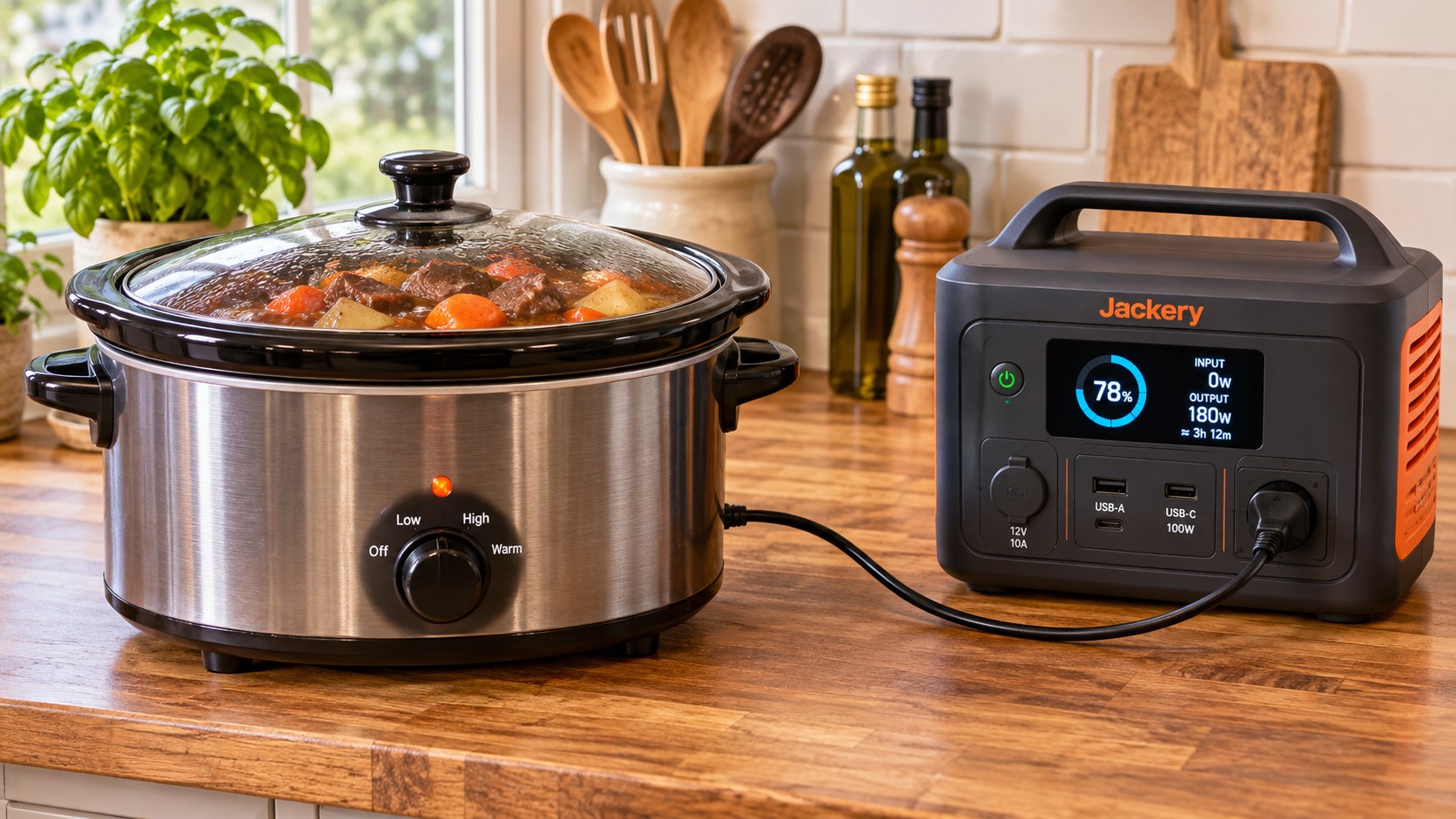
Direct answer: Yes, but it is an energy problem rather than a power problem. A typical slow cooker averages 150–250 W, so an eight-hour low cook uses 1.2–1.6 kWh; a 2 kWh station covers it comfortably, a 1 kWh station only just.
Editorial note: WhichWatts is an independent comparison site. Prices, availability, specifications, and retailer promotions change frequently. Check the live product table and retailer page before buying.
Can a Power Station Run a Slow Cooker for 8 Hours?
Slow cookers are the opposite of kettles: low wattage, long duration. That makes them easy on the inverter and demanding on the battery. A 200 W appliance sounds trivial until you multiply it by eight hours.
This guide uses measured UK appliance data and the site's standard efficiency factor to show what a slow cooker really costs in watt-hours, and which station size finishes the cook.
The short answer
Yes — a 1 kWh station can run a small slow cooker for most of an eight-hour cook, and a 2 kWh station will finish it with reserve. The typical 3.5 litre cooker averages 150–250 W on low. At 180 W, eight hours is 1.44 kWh delivered, which needs about 1.9 kWh of rated capacity after inverter and depth-of-discharge losses.
How much power does a slow cooker use?
Slow cookers are rated 150–300 W, and the element cycles to hold temperature. The average draw is therefore lower than the label, especially on the low setting.
| Setting | Typical rating | Average draw | 8-hour energy |
|---|---|---|---|
| Low | 150–200 W | 100–180 W | 0.8–1.4 kWh |
| High | 250–300 W | 200–280 W | 1.6–2.2 kWh |
| Warm | 50–100 W | 30–80 W | 0.2–0.6 kWh |
A UK appliance-monitoring study measured a small slow cooker using 0.81 kWh over eight hours on low, rising to 160 W when switched to high near the end. That is a useful real-world anchor: the nameplate says 150–300 W, but the measured average was closer to 100 W.
How long will a power station run a slow cooker?
The table below uses a conservative 180 W average, so it will under-promise on efficient models:
| Station size | Usable energy | Low-setting hours | High-setting hours |
|---|---|---|---|
| 500 Wh | 383 Wh | 2.1 | 1.4 |
| 1,000 Wh | 765 Wh | 4.2 | 2.7 |
| 2,000 Wh | 1,530 Wh | 8.5 | 5.5 |
| 3,600 Wh | 2,754 Wh | 15.3 | 9.8 |
| 5,000 Wh | 3,825 Wh | 21.3 | 13.7 |
With the measured 0.81 kWh example, a 1 kWh station would just finish an eight-hour low cook. With a larger or older cooker averaging 180 W, it would not. If an eight-hour cook matters, buy 2 kWh.
The inverter question is easy
A slow cooker draws 150–300 W, so almost any power station can supply it. The things to check are:
- Continuous output of at least 300 W — every station in this class clears that.
- Pure sine wave if the cooker has a digital control board or probe.
- Ventilation around the station; a slow cooker radiates heat for hours.
- Cable routing so nobody trips over the lead in a kitchen.
This is one of the few cooking appliances where a compact station is genuinely adequate on power. Capacity is the only real constraint.
Which power stations suit a slow cooker?
| Station | Capacity / continuous output | Why it fits |
|---|---|---|
| EcoFlow DELTA 2 | 1,024 Wh / 1,800 W | One full low cook, with little reserve |
| Anker SOLIX C1000 | 1,056 Wh / 1,800 W | Same class; check the measured cook time |
| Bluetti AC200L | 2,048 Wh / 2,400 W | Finishes an eight-hour cook with margin |
| EcoFlow DELTA 2 Max | 2,048 Wh / 2,400 W | Two long cooks or one cook plus fridge |
| Anker SOLIX F3800 | 3,840 Wh / 6,000 W | Multi-day cooking or catering |
Cooking smarter on battery
- Use the low setting. It is the whole point of a slow cooker and uses roughly half the energy of high.
- Start with hot ingredients. Filling the pot with boiling water from a gas kettle cuts the energy the element must supply.
- Keep the lid on. Every lift dumps heat and adds cooking time.
- Cook during the day, not overnight. If you have solar, the battery refills while the cooker runs.
FAQ
How long will a 1 kWh station run a slow cooker?
About four hours at a conservative 180 W average, or close to eight hours for a small cooker that measures around 100 W average. Treat eight hours on 1 kWh as marginal.
Can I run a slow cooker overnight on a power station?
Yes, if the station has the capacity and is on a stable, ventilated surface. A 2 kWh station is the safer choice for an eight-hour overnight cook, and LiFePO4 is preferable for deep overnight discharge.
Low or high — which uses less energy?
Low uses less energy per hour but takes longer. Over a full cook, low is usually the lower-energy option, and it is what the recipes are designed for.
Slow cooker or microwave on a battery?
The microwave is far more efficient for reheating a portion. The slow cooker wins when you want a long, unattended cook and have the capacity to spare.
Amazon price checks: slow cookers · portable power stations. As an Amazon Associate, WhichWatts earns from qualifying purchases.
Sources
- National Energy Action: appliance monitoring report (measured slow-cooker run)
- National Energy Action: electricity consumption around the home
- US Department of Energy: estimating appliance energy use