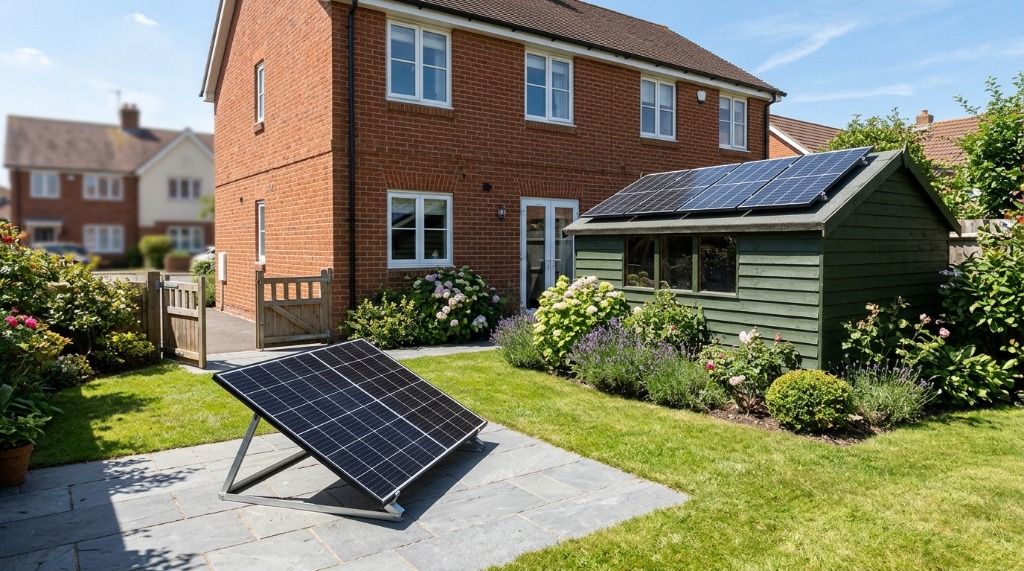
Direct answer: Trenching armoured mains cable (£1,500–£3,000) vs building an off-grid solar generator setup for a garden room. Full load breakdown, winter solar shortfall calculations, and realistic equipment kits.
Editorial note: WhichWatts is an independent comparison site. Prices, availability, specifications, and retailer promotions change frequently. Check the live product table and retailer page before buying.
Garden Office and Shed Solar Sizing: Standalone Battery Setup vs Trenching Mains Power
The rise of hybrid working has turned the garden office, summerhouse, and workshop into permanent fixtures of UK and European homes. But once the timber building is erected at the end of the garden, owners face an immediate financial fork in the road: should you pay an electrician to dig a trench across your lawn to run mains electricity, or can a standalone solar panel and battery setup power your workday off-grid?
Both approaches are viable, but their financial and operational profiles are radically different. Trenching mains carries high upfront excavation costs but guarantees unlimited power. An off-grid solar generator setup costs significantly less upfront and can be installed DIY in an afternoon — but it must be carefully engineered to survive the UK's harsh winter solar shortfall.
This comprehensive guide breaks down the true installation costs, daily office energy consumption, solar panel sizing for dark winter months, and the critical problem of heating.
Cost Comparison: Trenching Mains vs Standalone Solar Kit
Connecting a garden office 20 to 40 metres away from the main house requires compliant Part P electrical installation under UK Building Regulations.
| Cost Element | Trenching Mains Power (SWA Armoured Cable) | Standalone Solar & Battery Generator Kit |
|---|---|---|
| Materials / Hardware | 3-core Steel Wire Armoured (SWA) cable, outdoor consumer unit, RCDs, earth rod (£350 – £600) | 800W–1,200W solar panels, mounting brackets, 2kWh LiFePO4 power station (£900 – £1,500) |
| Labour & Excavation | Hand digging 500mm trench through lawn/patio, routing, Part P certification (£900 – £2,200) | DIY mounting on shed roof & plug-and-play MC4 cable connection (£0 – £200) |
| Total Typical Cost | £1,250 – £2,800+ | £900 – £1,700 |
| Running Cost | Uses household grid tariff (e.g. 25p–30p/kWh) | £0.00 / 100% Free Solar Energy |
| Grid Outage Resistance | None (office loses power during grid blackouts) | Immune to power cuts (independent microgrid) |
For garden buildings situated far from the main dwelling — especially where trenches would have to cross extensive block paving, mature flower beds, or concrete patios — an off-grid solar battery system frequently beats the cost of contractor trenching before you even account for electricity savings.
Daily Energy Audit: What Does a Home Office Actually Consume?
A common mistake is guessing equipment wattage instead of measuring it. Modern IT equipment is remarkably energy efficient:
| Office Device | Average Operating Power | Daily Operating Hours | Total Daily Watt-Hours (Wh) |
|---|---|---|---|
| Laptop (MacBook Pro / ThinkPad USB-C) | 35W – 65W | 8 hours | 360Wh |
| Dual 27-inch 4K Monitors | 50W – 70W total | 8 hours | 480Wh |
| Wi-Fi Mesh Node / 4G Router | 8W – 15W | 9 hours | 100Wh |
| LED Desk & Room Lighting | 12W – 20W | 6 hours | 90Wh |
| Phone & Accessory Charging | 10W – 20W | 2 hours | 30Wh |
| Baseline Daily Workday Total | ~120W – 170W average | 8-hour workday | ~1,060Wh (1.06kWh) |
Running a full professional workstation requires roughly 1.0kWh to 1.2kWh per day.
A modern 2,000Wh (2kWh) portable power station (such as an EcoFlow DELTA 2 Max, Bluetti AC200L, or Anker SOLIX C1000 with expansion pack) easily covers an entire workday on battery alone with 40% reserve capacity remaining.
The Winter Reality: Sizing Solar for the UK Solar Deficit
While generating 1.2kWh per day is trivial between April and September (when a single 400W panel generates 1.6kWh to 2.2kWh daily), winter in Northern Europe tells a very different story:
- June Average Peak Sun Hours (UK): ~4.8 hours/day → A 400W array produces ~1,900Wh/day.
- December Average Peak Sun Hours (UK): ~0.8 hours/day → A 400W array produces only ~320Wh/day.
If your office consumes 1,100Wh daily, a modest 400W solar array will experience a daily deficit of nearly 800Wh in December and January.
Recommended Off-Grid Solar Sizing for Year-Round Reliability
To keep your garden office self-sufficient throughout the darker winter months:
- Solar Array: Install 800W to 1,200W of monocrystalline panels flat or tilted at 35° on your shed roof (e.g. three 400W rigid panels). In December, an 1,000W array generates approximately 800Wh–1,100Wh on average overcast days.
- Battery Capacity: Choose a 2kWh to 3kWh LiFePO4 battery base. This provides a 2-day buffer for protracted storm systems when solar yield drops near zero.
- Winter Top-Up Fallback: On the 4 or 5 darkest weeks of mid-winter, carry the portable power station indoors once every 3 days to fast-charge it from the mains in 70 minutes, or run a temporary outdoor extension lead for a weekly top-up.
The Elephants in the Room: Heating and Air Conditioning
Heating is the primary reason off-grid garden offices fail when poorly planned.
A small 1,500W electric fan heater or oil radiator consumes 1,500Wh every single hour. Running it for an 8-hour workday consumes 12,000Wh (12kWh) — ten times more energy than all your computer equipment combined. Sizing a solar and battery system to carry 12kWh of electric space heating in winter would cost upwards of £6,000 to £8,000.
Smart Heating Alternatives for Off-Grid Offices
- Super-Insulation First: Ensure the shed has 100mm Celotex/Kingspan in floor, walls, and ceiling, with double-glazed doors.
- Targeted Personal Heating: Use a heated desk mat (45W) and a heated chair pad (35W). Warming your body directly requires under 90W total — easily handled by the solar battery.
- Dedicated Diesel / LPG Air Heater: Install a sealed, externally vented diesel parking heater (such as an Autoterm / Eberspächer or Chinese diesel heater). It burns ~0.15 litres of fuel per hour to deliver 2kW–4kW of dry, clean heat, requiring only 15W–25W of 12V electrical power to run its fan.
Recommended Equipment Spec
For a bulletproof standalone garden office setup:
- Power Station: 2,048Wh LiFePO4 capacity with 2,000W+ pure sine wave inverter and 1,000W+ MPPT solar input.
- Solar Panels: Two or three 400W–430W rigid panels wired in series or series-parallel within the power station's MPPT voltage limit (check our solar cable sizing guide).
- Mounting: Z-brackets or unistrut rails secured into shed roof trusses.
Calculate your exact solar yield with the solar panel sizing calculator and compare battery models in our price comparison table.
Shop 2kWh Garden Office Solar Kits
Check live generator and solar panel bundle prices for off-grid outbuildings:
FAQ
Can I run a desktop gaming/workstation PC on a garden office solar setup?
Yes. High-performance desktop PCs with multi-monitor setups typically draw 250W–400W under load, consuming roughly 2.0kWh to 3.2kWh over an 8-hour day. Pair with a 3kWh battery and at least 1,200W of solar panels for reliable year-round operation.
Do I need planning permission for solar panels on a garden shed or office?
In England, solar panels on outbuildings within domestic curtilage fall under Permitted Development (Class A or Class B of Part 14 GPDO), provided they do not protrude more than 200mm from the roof plane and the building is not within a conservation area or listed curtilage. See our plug-in solar placement guide.
Can I plug a mini-fridge into the garden office power station?
A modern A-rated counter-height mini fridge consumes only 15W–25W average (around 150Wh–250Wh per 24 hours), which is easily accommodated. Avoid older, unrated bar fridges which can draw 500Wh+ daily.