Off-Grid Solar System: Components, Sizing and Costs
An off-grid solar system generates, stores, and delivers all the electricity a site uses. It needs panels, a charge controller, a battery bank, an inverter, and appropriate safety equipment. Size it from daily kWh and days of autonomy, then size the array to recharge the battery in the worst realistic month, not from panel wattage alone.
By WhichWatts editorial team · Updated October 25, 2026
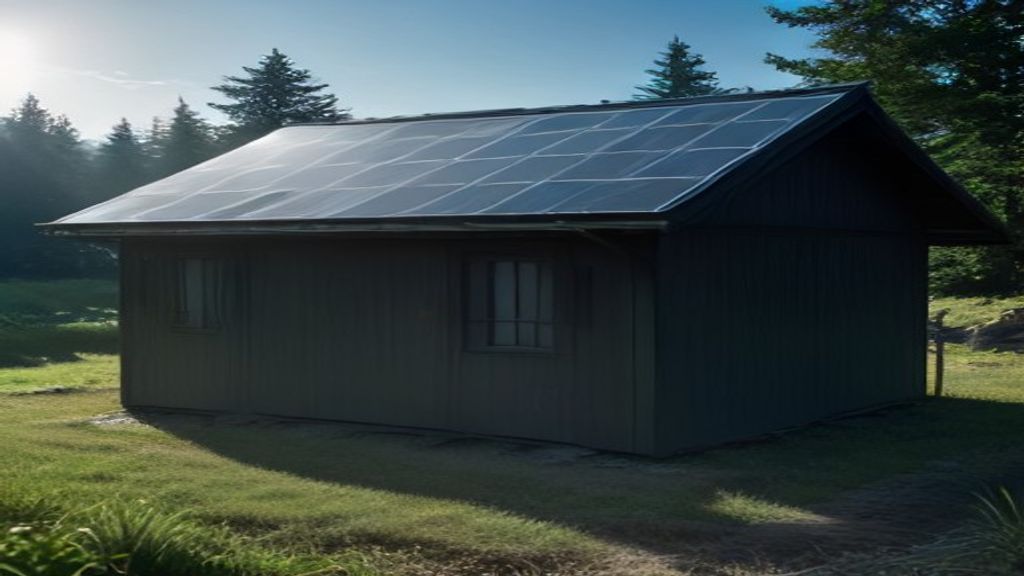
What is an off-grid solar system?
An off-grid solar system makes, stores, and delivers all the electricity a site uses without a utility connection. It combines a PV array, charge controller, battery bank, inverter, and safety equipment. A grid-tied solar system with battery backup is different because it can still import and export grid electricity.
Off-grid systems range from a small cabin with lights and a router to a full-time home with a well pump, refrigeration, and workshop tools. The common constraint is that every watt-hour must be generated on site and stored until it is needed. There is no utility to cover a cloudy week.
A portable power station with a folding panel is a small off-grid system, but it is not a substitute for a whole-home design. Portable systems have limited battery capacity, small inverters, and few installation options. A fixed system uses separate components, larger batteries, and code-compliant wiring.
“Off-grid” does not mean “unregulated.” Fixed wiring, battery installations, and rooftop arrays are subject to local permits and electrical codes. A generator, if used, adds fuel storage, ventilation, and carbon-monoxide safety requirements.
The U.S. Department of Energy’s Solar Integration: Solar Energy and Storage Basics explains the difference between energy capacity and power capacity, which is the same distinction you need when sizing the battery and inverter.
What components does an off-grid solar system need?
The minimum is a PV array, a charge controller, a battery bank, an inverter, and the wiring and protection devices that connect them. A practical system also has a main disconnect, fuses or breakers, grounding, monitoring, and a mounting structure designed for local wind and snow loads.
| Component | What it does | What to check |
|---|---|---|
| PV array | Converts sunlight into DC electricity | Wattage, Voc and Vmp, snow and wind load, shading, tilt |
| Charge controller | Regulates charging and protects the battery | MPPT or PWM, maximum PV voltage and current, battery voltage, temperature compensation |
| Battery bank | Stores energy for night and cloudy periods | Usable kWh, depth of discharge, cycle life, temperature limits, ventilation |
| Inverter or inverter/charger | Converts DC to AC and may charge from a generator | Continuous and surge watts, idle draw, AC voltage, efficiency, transfer behaviour |
| Balance of system | Fuses, breakers, disconnects, grounding, cable, monitoring | Cable ampacity, voltage drop, labels, outdoor ratings, service access |
| Generator (optional) | Covers long low-sun periods or heavy loads | Fuel, ventilation, exhaust, transfer switch, charger compatibility |
The charge controller is not interchangeable with the inverter. The controller sits between the array and the battery and manages charging. The inverter sits between the battery and the AC loads. An inverter/charger combines the inverter with a battery charger and transfer equipment, which is common in off-grid systems that also use a generator.
For the array, see solar panel types. For the AC side, see the solar inverter guide. For the battery chemistry and usable-capacity trade-offs, see solar battery storage.
How do I calculate daily energy use?
Build a load table in watt-hours per day. For each device, multiply its running watts by the hours it runs and by its duty cycle if it cycles on and off. Add the loads you will run at the same time, separate essential from discretionary use, and add a design margin for losses and aging.
The formula is:
watt-hours per day = watts × hours per day × duty cycle
An illustrative cabin load table might look like this:
| Load | Running watts | Hours or duty | Daily Wh |
|---|---|---|---|
| LED lights | 10W | 5 hours | 50 |
| Router and modem | 10W | 24 hours | 240 |
| Laptop | 60W | 4 hours | 240 |
| Refrigerator | 60W | 8 hours equivalent | 480 |
| Well pump | 750W | 1 hour | 750 |
| Phone and small devices | 10W | 4 hours | 40 |
| Total | 1,800 |
This is a planning example, not a recommendation for a specific home. Measure the actual loads where possible. A fridge’s compressor cycles, a well pump’s runtime depends on water use, and a heater or induction cooktop can dwarf everything else.
Separate the loads you truly need during a cloudy week from the ones you can defer. A system sized for every convenience is much larger and more expensive than one that protects refrigeration, communications, lighting, water, and medical equipment.
Add a design margin of roughly 20–30% for inverter losses, wiring, temperature, and battery aging. That margin is not a substitute for measuring the loads; it covers the uncertainty you cannot remove.
How do I size the battery bank?
Battery nameplate kWh = daily AC kWh × days of autonomy ÷ inverter efficiency ÷ usable depth of discharge. Add an aging margin. A 3 kWh/day load with two days of autonomy, 90% inverter efficiency, and 80% usable depth needs about 8.3 kWh of nameplate storage before aging.
Work through the units in order:
- AC energy needed: daily kWh × autonomy days. For 3 kWh/day and 2 days, that is 6 kWh of AC energy.
- DC energy from the battery: divide by inverter efficiency. At 90%, 6 ÷ 0.9 = 6.67 kWh.
- Nameplate battery capacity: divide by usable depth of discharge. At 80%, 6.67 ÷ 0.8 = 8.33 kWh.
- Aging and reserve: add 10–20%, giving roughly 9.2–10 kWh of nameplate capacity.
The depth-of-discharge assumption is chemistry-specific. Lead-acid batteries are often limited to about 50% depth of discharge for reasonable cycle life; LiFePO4 is commonly specified at 80–90%. Round-trip efficiency also differs: lead-acid is typically lower, while lithium is usually higher. Use the manufacturer’s datasheet and the warranty conditions, not a generic rule.
Temperature matters. A cold battery room reduces usable capacity, and a hot one can shorten life. The battery needs ventilation, physical protection, and a location that stays within its operating range.
For a portable comparison, the Battery Price Index reports median US portable-station dollars per watt-hour. It is not a fixed-installation storage quote; use it as a benchmark, then get itemized quotes for the battery, inverter, racking, and installation you actually need.
How do I size the solar array?
Array kW = daily kWh to replace ÷ (peak sun hours × system efficiency). Use the worst realistic month for a critical off-grid site, not the annual average. A 3 kWh/day load with 3.5 peak sun hours and 80% system efficiency needs about 1.07 kW of nominal array before adding margin.
The formula gives a first-pass nameplate array:
array kW = daily kWh ÷ (peak sun hours × system efficiency)
For 3 kWh/day, 3.5 peak sun hours, and 80% system efficiency:
3 ÷ (3.5 × 0.8) = 1.07 kW
Add a design margin for cloudy days, soiling, aging, and temperature. A 20–30% margin puts the array around 1.3–1.4 kW. If the site is critical and winter sun is poor, use winter peak sun hours and consider a generator rather than an oversized array that sits idle in summer.
Peak sun hours are not daylight hours. They represent the equivalent number of hours at 1,000 W/m². A site with four peak sun hours receives roughly 4 kWh/m²/day of irradiation. NLR’s PVWatts estimates production for a location, tilt, azimuth, and system size.
The array must also be electrically compatible with the charge controller. Check the cold-weather open-circuit voltage of the string, the controller’s maximum PV voltage, its maximum current, and its supported battery voltage. Over-paneling in watts may be acceptable in some designs, but only when the controller explicitly allows it.
Use the solar panel sizing calculator for a quick scenario, then verify the result against the equipment manuals and a site-specific estimate.
How do I size the inverter?
Size the inverter for the continuous watts you will run at once and the largest motor’s starting surge. Add the simultaneous loads, then check the pump, fridge, or tool’s locked-rotor or startup current. A 2–3× surge for a second or two is common, but the datasheet is the authority.
An inverter’s continuous rating is the power it can deliver indefinitely at a specified temperature. Its surge rating is a short-term overload for motor starts and other inrush. A 2,000W inverter may start a small well pump but trip on a larger one, even if the pump’s running wattage looks fine.
Example: a small well pump might draw roughly 750W while running and two to three times that during startup. Add the fridge, lights, and electronics that are on at the same time, then choose an inverter with continuous headroom above the steady load and a surge rating above the motor start.
Other checks:
- Battery voltage: 12V, 24V, or 48V changes cable size and current. Higher voltage usually means smaller cables and lower losses for the same power.
- Idle draw: an inverter can consume tens of watts while doing nothing. That matters in a small off-grid system.
- Temperature derating: an inverter may not deliver its full rating in a hot enclosure.
- AC output: voltage, frequency, split-phase or single-phase, and whether the load is hard-wired or plug-in.
- Generator input: if you plan to charge from a generator, confirm the inverter/charger supports the generator’s waveform and power.
For a deeper comparison of inverter types, see the solar inverter guide.
What drives the cost of an off-grid system?
The battery usually dominates the budget, followed by the array, inverter, mounting, wiring, and labor. Compare itemized quotes and usable dollars per kilowatt-hour of storage, not sticker price. A generator can be cheaper than adding enough battery for the darkest week, but it adds fuel, maintenance, and safety requirements.
Off-grid costs are site-specific. A cabin with a short wire run, a simple array, and a small DC load is a different project from a full-time home with a well pump, a heated battery room, and a code-compliant backup panel. Ask for a quote that separates:
- PV modules and mounting
- Charge controller and inverter/charger
- Battery bank and racking
- Cable, fuses, disconnects, and grounding
- Labor, permits, engineering, and inspection
- Generator, fuel storage, and ventilation, if included
- Monitoring, service, and replacement reserves
Compare storage on usable kWh, not nameplate kWh. A 10 kWh lead-acid bank with a 50% depth of discharge offers roughly 5 kWh of usable energy before efficiency losses; a 10 kWh LiFePO4 bank with 90% usable depth offers closer to 9 kWh. The upfront price difference can be partly offset by using less battery for the same useful energy.
Do not size the battery for the worst week of the decade and ignore the generator. A hybrid design that uses a generator for long cloudy stretches can be more economical than a very large battery that sits full most of the year. The right balance depends on fuel access, noise, maintenance, and how critical the loads are.
What safety and code requirements apply?
Fixed off-grid wiring needs overcurrent protection, disconnects, grounding, correctly sized cable, and compliance with local electrical codes. Battery rooms need ventilation and fire planning. Use a licensed electrician for household wiring, inspection, and any connection to a building’s electrical panel.
In the United States, NFPA 70 (the National Electrical Code) is the baseline for wiring methods, grounding, overcurrent protection, and disconnects; local amendments and permits still apply. A rooftop array may need rapid shutdown, labeling, and a mounting design rated for wind and snow. A battery system needs a disconnect, short-circuit protection, and a location that limits fire spread and keeps the battery within its temperature range.
Lead-acid batteries can vent hydrogen during charging, so the enclosure needs ventilation and no ignition sources. Lithium batteries need protection from physical damage, water intrusion, and overheating; follow the manufacturer’s installation manual and local fire guidance. Do not mix chemistries, ages, or states of charge in one bank unless the manufacturer explicitly supports it.
An off-grid inverter is not automatically approved for grid interaction. If a building has utility service, a transfer switch or approved interconnection is required to prevent backfeeding the grid. Islanding is a safety issue for utility workers. IEEE 1547 and UL 1741 are relevant to grid-interactive equipment; an off-grid inverter may not carry those listings because it is not designed to parallel with the grid.
If you are not trained for this work, do not wire a house panel, battery bank, or rooftop array yourself. Use a licensed electrician and a qualified solar installer.
Can a portable power station be an off-grid system?
For a small load, yes. A portable power station with folding panels can run lights, communications, a laptop, or a small fridge in a cabin or shed. It is not a whole-home off-grid system: the battery, inverter, wiring, and expansion limits are much smaller than a fixed installation.
A portable system is the right tool when you need plug-and-play power, can carry the battery, and do not need permanent wiring. It is a poor fit when you need a well pump, central refrigeration, a 240V load, or a system that grows with a house.
Compare the two on the load, not the label:
| Question | Portable power station | Fixed off-grid system |
|---|---|---|
| Typical use | Camping, cabin, temporary backup | Full-time home, remote site, large loads |
| Battery size | Usually 0.5–5 kWh | Often 5–30+ kWh |
| Inverter | Usually 0.5–5 kW | Several kW, with hard-wired loads |
| Installation | Plug-in | Permits, wiring, inspection |
| Expansion | Model-specific | Modular battery and array |
| Maintenance | User-managed | Service plan and monitoring |
For a small setup, start with the power station sizing calculator and the battery backup guide. For a fixed system, use the sizing steps above and get a site-specific design.
Where to start shopping
The three lowest cost-per-watt-hour stations in the live US catalog. Affiliate links; the ranking is not paid.


Retailer links are affiliate links. WhichWatts may earn a commission; the shortlist is ranked by cost per watt-hour, not by commission.
Shop by brand
Direct links to manufacturer stores. These are affiliate links and we may earn a commission.
Compare before you buy
Browse every model · Cost per watt-hour chart · Best for home backup · Size a system for your appliances
Common questions
How many solar panels do I need for an off-grid system?
Estimate daily kWh, choose conservative peak sun hours, and use array kW = daily kWh ÷ (peak sun hours × system efficiency). A 3 kWh/day load with 3.5 peak sun hours and 80% efficiency needs about 1.07 kW of nominal array before margin. Panel wattage and controller voltage limits then determine how many modules that is.
How many batteries do I need for off-grid solar?
Use battery nameplate kWh = daily AC kWh × autonomy days ÷ inverter efficiency ÷ usable depth of discharge. A 3 kWh/day load with two days of autonomy, 90% inverter efficiency, and 80% usable depth needs about 8.3 kWh before aging. Divide by the battery’s usable kWh to get the number of units.
Can I use a portable power station as an off-grid system?
For a small cabin, shed, or temporary setup, yes. A portable station can run lights, communications, a laptop, and a small fridge. It is not a whole-home system because its battery, inverter, and wiring are limited. Use a fixed system for well pumps, large appliances, or permanent household circuits.
Do I need a generator for an off-grid system?
Not always, but a generator is useful in cloudy or winter conditions when the array cannot recharge the battery. Size it for the charger and the loads you need to run, and install it with proper ventilation, exhaust, fuel storage, and transfer equipment. A generator is a supplement, not a substitute for a safe electrical design.
Is lead-acid or lithium better for off-grid storage?
Lead-acid is cheaper upfront but heavier, shorter-lived, and usually limited to about 50% depth of discharge. LiFePO4 costs more upfront but typically offers deeper usable capacity, higher round-trip efficiency, and longer cycle life. Compare usable kWh, warranty, temperature limits, and the cost of replacement, not just the sticker price.
Can I connect an off-grid solar system to my house panel?
Only with approved transfer equipment and a code-compliant installation. An off-grid inverter is not designed to parallel with utility power, and backfeeding a panel can injure utility workers. Use a transfer switch or a professionally designed interconnection, and have the work inspected.
Sources
- U.S. Department of Energy — Solar Integration: Solar Energy and Storage Basics — Energy capacity versus power capacity, and how storage supports solar.
- U.S. Energy Information Administration — Photovoltaics and electricity — PV cells, panels, arrays, and the inverter’s role.
- National Laboratory of the Rockies — PVWatts — Location-specific PV energy estimates with tilt, azimuth, and losses.
- NFPA 70 — National Electrical Code — U.S. wiring, grounding, overcurrent, and disconnect requirements.
- IEC — Standards portal — IEC 62109 covers safety of power converters for PV systems.
Related: Solar panel types · Solar inverter guide · Solar battery storage · Battery capacity explained · Battery Price Index · Solar panel sizing calculator
WhichWatts is independent and funded by affiliate commission. Figures come from manufacturer specifications and the live catalog; see our methodology. Corrections to hello@whichwatts.com.